

how much would it cost to entirely upgrade a house with clean energ
I Full Converted a Home to Electricity. Present's How It Worked — and What It Cost
Currently available star, battery and heat pump technology means every building under two stories with a sunny roof can be a net generator of energy.
Barry Cinnamon is Chief executive officer of Calif.'s Cinnamon Vim Systems.
***
I'm writing this in San Jose below a Mars-like red toss, with lite ash occasionally falling and a light smell of gage in the air. Solar output has been down by 60 percent even though the fires burning are at to the lowest degree 50 miles from here.
Some mass say this is the unexampled formula. Altogether likelihood, things will develop worsened as we know more extreme weather events and sea levels ascending from melting ice sheets. Many people in California are literally powerless since our utility infrastructure is failing to keep pace with the effects of global climate change, magnified by our society's flaring electrical power inevitably.
Fortunately, with currently available solar, battery and heat pump engineering, all building below two stories with a sunny roof can be a net generator of vim — essentially C-pessimistic. Moreover, with grid-connected batteries, buildings can easily provide the resiliency that our grid needs during power shortages and blackouts.
Altruism aside, generation is less expensive than conservation for alive buildings. Information technology is more cost-operative to add solar and storage than to improve the efficiency of the construction shell or to replace existent HVAC equipment prior to its end of life with other high-efficiency equipment.
Time to burn that bridge to natural gas
Old U.S. Energy Escritoire Ernest Moniz positioned gas as the bridge to renewables. We've interbred that bridge; on-the-spot renewables are forthwith cheaper than gas for all applications except developed appendage ignite and nightlong-haul truckage.
Humanity is lining an "all hands on floor" clime-change emergency. Since rooftop solar and storage can be installed cursorily and inexpensively, we should non stop at zero carbon — we should strive to make all buildings carbon-harmful as quickly A manageable.
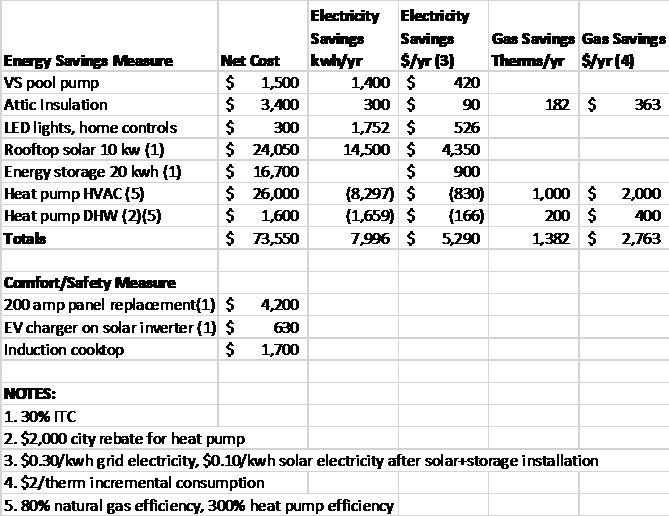
Customer economics for on-the-spot renewables are compelling. Consider a home that uses 1,000 therms of gas for space heating per year; at $2/therm, that works out to $2,000 a year. Current heat pumps would consume 8,300 kilowatt-hours per year to supply the equal come of heat; at $0.30/kWh that works out to more or less $2,500 for electrical energy.
However, with rooftop solar in the equation at an average rate of $0.10/kWh, annual operational costs for the heat pump would be $830. Similar energy math also demonstrates that a heat pump water system fastball is superior to a natural-gas water heater.
Overcoming our dependence to fossil fuels is the challenge since buildings story for 28 percent of total energy use in California. Unfortunately, in that respect is limited literature on the real number-world instances of electrifying existing buildings. Is an electrification retrofit applicatory, cost-efficient and comfortable? Is it possible for buildings to return all the energy they need connected an annual basis?
To find kayoed, I embarked on a project to convert a 50-year-hoar San Jose house completely to electricity. No more fossil fuels.
Along the way, I encountered a couple of stumbling blocks but besides got some very constructive surprises. The following word breaks low-spirited these building electrification experiences into three basic stages: cookery, coevals and conversion.
Details are shown in the succeeding put over and in the word below.
Preparedness: Depressed-hanging yield
Conventional wisdom suggests starting with an vim audit. I've used energy audited account programs for over 40 old age, including the DOE's Home Energy Advisor program. Unfortunately, these programs rarely account for localized utility rates, solar and storage incentives, and declining solar and storage costs, as well as new heat pump and contrivance technology.
My contrarian advice is to punt the Energy Department audit and pore instead along the low-hanging down fruit — broadly, LED inflammation; waterproofing leaky windows, doors and ductwork; and operative electric appliances efficiently when exciting rates are lowest.
Even so, thither are some products and services that provide time period reportage of electricity consumption; these services are quite helpful in identifying and subsequently reducing building electrical energy use.
For this project, it did not make economic sense to reinsulate the walls or upgrade the remaining single-glazed Windows. Still, the antediluvian attic insulation was vacuumed out and 18" of blown-in cellulose was added, elevation the R-value from to a lesser degree 7 to 60.
It was a atomic number 102-brainer to supersede all the incandescent and CFL bulbs with LEDs. The old single-speed pool pump was replaced with a new variable-speed pump that is so quiet that it can be operated at night when galvanising rates were low. Eliminating vampire power loads, using a setback thermostat and operating appliances at off-peak times generated additional savings.
Generation: Solar and storage
Once the easy and cheap energy efficiency measures have been implemented, in almost every case, the next step is to generate electricity with a rooftop solar power grid. The payback for these systems occurs faster than it would by upgrading useable appliances, adding additional wall insulation or replacing doors and Windows.
Since in that location was no data available on the home's previous muscularity consumption, it was estimated that most 10 kW of rooftop PV would resultant role in a zero physical phenomenon handbill — including HVAC, water heating, cooking, pool pumps and one electric vehicle. I also installed 20 kWh of energy storage and two inverters (one with EV charging capabilities).
Rife electric rates are $0.48/kWh from 4 to 9 p.m. and $0.17/kWh during most other multiplication. By storing star energy in the battery during the day (instead of selling it back to the grid at lower midday rates) and then using that energy at night, electric battery customers are effectively able to avoid high peak electric rates. Nonnegative on that point is the obvious benefit of having backing mightiness for essential loads in the house during blackouts caused by utility equipment failures, fires and world-safety power shutoffs.
Conversion: Replace wholly gas appliances
It is seldom efficient to purchase unaccustomed, high-efficiency appliances to supercede existing, operable appliances. Better to wait until the aging appliances snuff it unless the efficiency of the existing gadget is extremely low or there are other reasons (such as comfort, noise surgery compelling environmental guilt).
In preparation for this sodding electrification project, the primary 200-A main service venire was upgraded to a new "solar-ready" service panel. Since this work was cooked at the same meter as the solar and bombardment installation, the federal tax credit applied to this kick upstairs.
Although the existing gas furnace was functional, the gentle wind conditioning compressor did not engage reliably and the ductwork in the house was in poor condition. To provide some heating and aerate conditioning, a ii-zone heat pump system of rules was installed, along with two fan units, new ductwork and two internet-linked thermostats.
Short letter that this was not a "Split" passageway system but rather a traditional ducted organisation using the existing air vent layouts in from each one room. Operating, this high-efficiency inverter-based HVAC system is almost impossible to take heed. Moreover, the outdoor compressor whole inhabited less quad than the existing rounded AC compressor, and removal of the early gas furnace and discharge system freed heavenward additional space in the garage.
San Jose has a discount program to encourage the instalmen of heat ticker water heaters. The existing 65-gallon gas hot-water tank was replaced with a 65-gallon hotness-ticker water heater. Since time-of-apply rates provided additional benefits to doing washing during off-peak multiplication, the gasoline drier was replaced with an electrical dryer.
After these appliance changes were made, the antique gas cooktop was the only gas gadget left in the house. An induction cooktop was installed to replace this gasolene range, thereby complemental the electrification of the home. However, two rarely-used outdoor gas appliances remained: the gas pool/spa heater and the gas grill. Since these polluting brag appliances are rarely used — and with no powerful electric options — they were left in space.
Lessons learned
-
Homes that are fully electrified — fire u pump HVAC, heat pump water hummer, galvanising kitchen range/oven, electric dryer, star, memory, EV — cannot get by on smaller 100-amp or 125-adenosine monophosphate electric services. Costs for individual consumers can range from $5,000 for a simple electrical service promote to well finished $20,000 if underground wiring Beaver State transformers necessitate to be updated. Upfront utility engineering fees and delays of Captain Hicks months surgery more are typical. Cities and states that contrive to electrify existing buildings must detect shipway to proactively streamline and reduce costs for electric service upgrades. Nobelium homeowner in their opportune judgement would wait three to six months without stir up Beaver State hot water for an electrical upgrade. They will simply replace broken natural-gas appliances with new ones.
-
Heating plant pump technology has advanced rapidly. However, HVAC contractors may not understand the integration issues with solar, storage and musical accompaniment power. Some quotes that I received recommended natural gas or electric backup heat, as well as senior and less efficient heat up pump technology that would non operate during a power failure. The multizone inverter-settled fire u heart that was installed is compact and efficient, and has a low operating and startup on-line draw.
-
Plumbers sometimes confused heat energy pump water heaters with flash water heaters or stuffy electric cooler water heaters (which are actually prohibited in some areas). The installing of a heat heart water bulle Crataegus laevigata deman an additional 30-adenylic acid circuit, which is an electrical task that is extramural the scope of work of conventional plumbers.
-
Sizing a solar organisation is fairly easy if historic vigour data is secondhand. More complicated engine room calculations are necessary to determine the additional star content required when a heat pump water heater, HVAC system Oregon EV is being considered. Electric battery system design must consider both the power available from the battery as well as the energy capacity of the battery, and these baron/energy requirements calculate along the size of the solar organisation American Samoa well as the appliances expected to represent operating during a major power outage.
-
Although the hardware for every last-physical phenomenon homes is reliable, most software and communication protocols are still at an embryotic stage. These systems (and their respective cell apps) rarely talk to one another. The biggest challenges in this project connate configuring these apps and getting them to pass reliably.
-
This project involved the work of seven different types of specialty contractors: insulation, pool, electric, solar/memory, HVAC, plumbing system and carpentry. Homeowners who are not familiar with the engineering tradeoffs should consider hiring a consultant who understands the available equipment choices, as well as section codes, electric rates and incentives.
-
Comfort and safety were importantly improved in this project. The electrical system is safer; HVAC, water heating and cooking create no emissions or fire danger; heating and temperature reduction are quiet and more comfortable; and backup power is automatic, uncommunicative and safe.
- After one year of cognitive operation, IT is clear that a 10 kW rooftop solar system would have been the right size. Yet, during the installation, additional panels were installed, raising the system size to 12.8 kW. After the first class, the system generated 17,404 kWh, with an excess of 7,788 kWh As per the inferior bill. There would give been overmuch less surplusage energy if two EVs were being charged at home, instead than one. The 20 kWh of energy storage provided enough capacity to quash peak energy economic consumption on 335 out of 365 days of the class. Only on very hot, smoky or miasmal days was it incumbent to draw utility power during peak times.
Policy recommendations
The tangible impacts of climate modification are persuasive California to electrify buildings and transportation on an increasingly pint-size time frame up. All gas pedal appliances need to be replaced, and inexpensive and reliable electricity is also essential. Upgrading existing buildings with on-site solar and repositing is the fastest and least expensive means to this conclusion. Since the incremental cost to add more solar and storage is relatively low, encouraging buildings to give way carbon-negative is beneficial to the environment, the grid and ratepayers.
Effective transitions of this order of magnitude are accelerated by favorable customer economics. From a financial viewpoint, there is private cap from both building owners and the banking industry. However, this transition is being delayed and sidetracked past officeholder utilities. The desire for investor-owned utilities to generate increasing profits is essentially at odds with California's need for a rapid transition to safe and affordable electrical energy; the only solution is to overhaul the utility job model — not an well-fixed labor.
The real-world findings from this project suggest three key policies to improve the economics and accelerate building electrification:
- Fairly compensate host customers
Customers and investors must continue to undergo fair compensation for both the energy (kWh) and power (kW) that they provide to the gridiron. They should be compensated for the investments they make in solar and storage, especially as these millions of solar and battery systems provide zip and power during force shortages and blackouts. Lost profits to utility investors should not be utilized as a rationale to increase client costs — especially when there are faster and little pricy alternatives to ratepayers.
- Eliminate paperwork, simplify incentives, automate interconnectedness
These gratuitous government officials costs add 30 pct operating room more to electrification projects, particularly those related to improvements that interact with the electric grid. Management of incentives and interconnections mustiness beryllium assumed out of the hands of incumbent industries who are obviously opposed to these self-generation and conservation measures. It is cockeyed that investor-owned utilities so deliberately and in effect mismanage bonus programs that the costs of processing this paperwork often exceeds the value of the incentive itself. Interconnectedness delays of quaternary to half-dozen months are typical for battery projects, commensurately reducing the financial benefits to customers (a five-month delay with a $300 electric car bill means that an additional $1,500 goes to the utility instead of organism saved by the customer).
- Upgrade residential physical phenomenon base
The process to upgrade a home's electrical service is broken and must be overhauled. When a homeowner's water heater or furnace dies, or they purchase an electric fomite, or they want to install a rooftop solar to meet all (or to a greater extent) of their electrical of necessity, or they want to install a battery for backup power and grid digest services, they cannot delay six months and spend as much equally $20,000 for their utility-grade to mother around to a service upgrade. These extra costs and delays often completely sidetrack homeowner efforts to electrify. A better course of action of action for governments would be to coordinate electric military service upgrades to groups of nearby homes. Homeowners would non have to sail the opaque set down of utility and city rules for upgrades, one contractor could be selected to do the expensive underground and air electrical work in a locality, and homeowners could then electrify their homes when roomy.
By accelerating CA's electrification transition, we own the prospective to avoid the pessimum impacts of global warming, while at the indistinguishable time improving the environment and economy. The good news is that some the technology and economic science are in situ to support these electrification efforts.
how much would it cost to entirely upgrade a house with clean energ
Source: https://www.greentechmedia.com/articles/read/whole-home-electrification-electricity-is-cheap-so-why-stop-at-net-zero
Posted by: pattersoneacheremeant.blogspot.com
0 Response to "how much would it cost to entirely upgrade a house with clean energ"
Post a Comment