

How Is The United Nations Going To Clean Up The Great Pacific Garbage Patch?

Swell Pacific Garbage Patch 2022
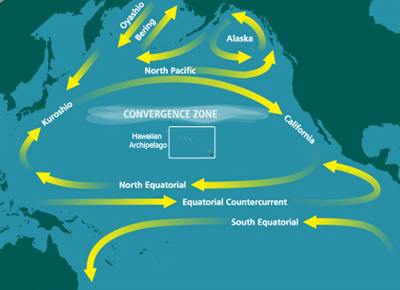
The patch is created in the gyre of the North Pacific Subtropical Convergence Zone.
The Great Pacific garbage patch (also Pacific trash vortex) is a garbage patch, a gyre of marine debris particles, in the central North Pacific Bounding main. It is located roughly from 135°West to 155°W and 35°N to 42°N.[1] The collection of plastic and floating trash originates from the Pacific Rim, including countries in Asia, North America, and South America.[2] The roll is divided into two areas, the "Eastern Garbage Patch" from California to Hawaii, and the "Western Garbage Patch" extending from Hawaii to Japan.
Despite the mutual public perception of the patch existing as giant islands of floating garbage, its low density (4 particles per cubic metre (3.1/cu yd)) prevents detection by satellite imagery, or even by coincidental boaters or divers in the area. This is because the patch is a widely dispersed area consisting primarily of suspended "fingernail-sized or smaller"—frequently microscopic—particles in the upper water cavalcade known equally microplastics.[3] Researchers from The Ocean Cleanup projection claimed that the patch covers 1.half-dozen meg square kilometres (620 thousand square miles).[4] Some of the plastic in the patch is over 50 years old, and includes items (and fragments of items) such as "plastic lighters, toothbrushes, water bottles, pens, infant bottles, prison cell phones, plastic numberless, and nurdles." The small-scale fibers of woods pulp found throughout the patch are "believed to originate from the thousands of tons of toilet paper flushed into the oceans daily."[3]
Research indicates that the patch is rapidly accumulating.[v] The patch is believed to take increased "10-fold each decade" since 1945.[6] Estimated to be double the size of Texas, the surface area contains more than three one thousand thousand short tons (two.seven million metric tons) of plastic.[7] The gyre contains approximately half-dozen pounds of plastic for every pound of plankton.[8] A similar patch of floating plastic droppings is establish in the Atlantic Bounding main, called the N Atlantic garbage patch.[ix] [10] This growing patch contributes to other ecology damage to marine ecosystems and species.
History [edit]
North Atlantic
gyre
N Atlantic
whorl
North Atlantic
gyre
Indian
Sea
gyre
North
Pacific
curlicue
Southward
Pacific
roll
S Atlantic
gyre
The patch was described in a 1988 paper published by the National Oceanic and Atmospheric Administration (NOAA). The description was based on inquiry by several Alaska-based researchers in 1988 who measured neustonic plastic in the North Pacific Ocean.[xi] Researchers found relatively high concentrations of marine debris accumulating in regions governed by ocean currents. Extrapolating from findings in the Sea of Japan, the researchers hypothesized that similar conditions would occur in other parts of the Pacific where prevailing currents were favorable to the creation of relatively stable waters. They specifically indicated the Due north Pacific Ringlet.[12]
Charles J. Moore, returning home through the Northward Pacific Gyre after competing in the Transpacific Yacht Race in 1997, claimed to have come upon an enormous stretch of floating droppings. Moore alerted the oceanographer Curtis Ebbesmeyer, who subsequently dubbed the region the "Eastern Garbage Patch" (EGP).[13] The area is oft featured in media reports as an exceptional instance of marine pollution.[fourteen]
The JUNK Raft Project was a 2008 trans-Pacific sailing voyage made to highlight the plastic in the patch, organized by the Algalita Marine Research Foundation.[15] [16] [17]
In 2009, two project vessels from Project Kaisei/Sea Voyages Institute; the New Horizon and the Kaisei, embarked on a voyage to enquiry the patch and determine the feasibility of commercial scale collection and recycling.[18] The Scripps Establish of Oceanography'southward 2009 SEAPLEX trek in part funded by Body of water Voyages Institute/Project Kaisei[19] too researched the patch. Researchers were too looking at the impact of plastic on mesopelagic fish, such as lanternfish.[20] [21]
In 2022, Ocean Voyages Plant conducted a xxx-twenty-four hours expedition in the gyre which continued the science from the 2009 expeditions and tested prototype cleanup devices.[22]
in July/August 2022 Ocean Voyages Institute conducted a voyage from San Francisco to the Eastern limits of the North Pacific Roll north, (ultimately ending in Richmond British Columbia) and then made a return voyage which also visited the Gyre. The focus on this expedition was surveying the extent of seismic sea wave droppings from the Japanese earthquake-seismic sea wave.[23] [24]
Sources of the plastic [edit]
In 2022, a study published in the journal Science sought to observe where exactly all of this garbage is coming from. According to the researchers, the discarded plastics and other droppings floats due east out of countries in Asia from six master sources: China, Indonesia, the Philippines, Vietnam, Sri Lanka and Thailand.[25] [26] In fact, the Ocean Salvation reported that People's republic of china, Indonesia, Philippines, Thailand, and Vietnam dump more than plastic in the sea than all other countries combined.[27] Communist china alone is responsible for 30% of worldwide plastic ocean pollution (China has approximately xviii% of the world'south population).[28] Efforts to dull land generated debris and consistent marine droppings accumulations take been undertaken past the Coastal Conservancy, Earth 24-hour interval, and World Cleanup Twenty-four hours.[29] [30] [31] [32]
Co-ordinate to National Geographic, "eighty percent of plastic in the ocean is estimated to come from land-based sources, with the remaining xx percentage coming from boats and other marine sources. These percentages vary by region, however. A 2022 written report found that constructed fishing nets fabricated up nearly one-half the mass of the Swell Pacific Garbage Patch, due largely to ocean current dynamics and increased fishing activity in the Pacific Bounding main."[33] [34]
In September 2022, when research revealed that much ocean plastic pollution comes from Chinese cargo ships,[35] an Ocean Cleanup spokesperson said: "Anybody talks about saving the oceans by stopping using plastic bags, straws and single-utilise packaging. That'south important, but when nosotros caput out on the bounding main, that's not necessarily what nosotros find."[36]
Constitution [edit]
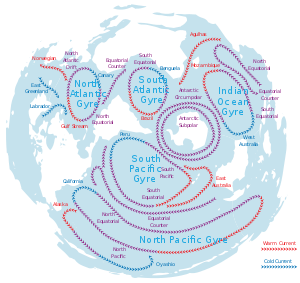
The n Pacific Garbage Patch on a continuous sea map
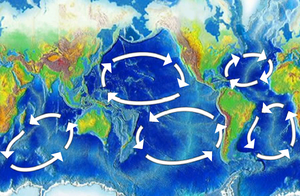
The Not bad Pacific garbage patch formed gradually as a result of ocean or marine pollution gathered past ocean currents.[37] It occupies a relatively stationary region of the Due north Pacific Ocean divisional by the North Pacific Ringlet in the equus caballus latitudes. The whorl's rotational pattern draws in waste product cloth from across the North Pacific, incorporating coastal waters off North America and Japan. As the material is captured in the currents, wind-driven surface currents gradually move debris toward the center, trapping it.
In a 2022 study[38] researchers sampled 1571 locations throughout the world's oceans and determined that discarded line-fishing gear such as buoys, lines and nets deemed for more than 60%[38] of the mass of plastic marine debris. According to a 2022 EPA written report, "The primary source of marine debris is the improper waste disposal or management of trash and manufacturing products, including plastics (e.m., littering, illegal dumping) ... Debris is generated on country at marinas, ports, rivers, harbors, docks, and tempest drains. Debris is generated at body of water from fishing vessels, stationary platforms, and cargo ships."[39] Constituents range in size from miles-long abandoned fishing nets to micro-pellets used in cosmetics and abrasive cleaners.[40] A calculator model predicts that a hypothetical slice of droppings from the U.S. west coast would head for Asia, and render to the U.South. in six years;[xiii] debris from the east coast of Asia would reach the U.Southward. in a year or less.[41] [42] While microplastics make upward 94% of the estimated ane.8 trillion plastic pieces, they amount to simply eight% of the 79,000 metric tons of plastic there, with nigh of the rest coming from the angling industry.[43]
A 2022 study concluded that of the 9.1 billion tons of plastic produced since 1950, close to 7 billion tons are no longer in use.[44] The authors gauge that 9% was recycled, 12% was incinerated, and the remaining 5.5 billion tons are in the oceans and land.[44]
Size estimates [edit]
Visualisation showing how mass accumulates in gyres.
The size of the patch is indefinite, every bit is the precise distribution of droppings because big items are uncommon.[45] Most droppings consists of small plastic particles suspended at or just below the surface, evading detection by shipping or satellite. Instead, the size of the patch is determined by sampling. The estimated size of the garbage patch is i,600,000 square kilometres (620,000 sq mi) (about twice the size of Texas or three times the size of France).[46] Such estimates, however, are conjectural given the complexities of sampling and the need to assess findings against other areas. Farther, although the size of the patch is determined past a higher-than-normal degree of concentration of pelagic debris, there is no standard for determining the boundary between "normal" and "elevated" levels of pollutants to provide a firm estimate of the affected expanse.
Internet-based surveys are less subjective than directly observations but are limited regarding the expanse that can be sampled (net apertures 1–2 m and ships typically have to slow down to deploy nets, requiring dedicated ship'due south fourth dimension). The plastic droppings sampled is determined past cyberspace mesh size, with like mesh sizes required to brand meaningful comparisons among studies. Floating debris typically is sampled with a neuston or manta trawl cyberspace lined with 0.33 mm mesh. Given the very high level of spatial clumping in marine litter, big numbers of net tows are required to adequately characterize the average affluence of litter at sea. Long-term changes in plastic meso-litter accept been reported using surface net tows: in the North Pacific Subtropical Gyre in 1999, plastic abundance was 335,000 items/km2 and 5.ane kg/kmtwo, roughly an society of magnitude greater than samples collected in the 1980s. Like dramatic increases in plastic droppings accept been reported off Nippon. However, caution is needed in interpreting such findings, because of the problems of extreme spatial heterogeneity, and the need to compare samples from equivalent water masses, which is to say that, if an examination of the same parcel of h2o a week apart is conducted, an order of magnitude change in plastic concentration could be observed.[47]
—Ryan et al
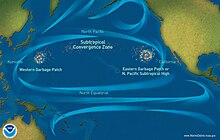
Pacific Bounding main currents have created iii "islands" of droppings.[48]
In August 2009, the Scripps Institution of Oceanography/Project Kaisei SEAPLEX survey mission of the Ringlet institute that plastic debris was present in 100 sequent samples taken at varying depths and net sizes along a path of 1,700 miles (2,700 km) through the patch. The survey establish that, although the patch contains big pieces, it is on the whole made up of smaller items that increase in concentration toward the roll's centre, and these 'confetti-like' pieces that are visible simply beneath the surface suggests the affected expanse may be much smaller.[47] [49] [fifty] 2009 data collected from Pacific albatross populations propose the presence of 2 distinct debris zones.[51]
In March 2022, The Sea Cleanup published a paper summarizing their findings from the Mega- (2015) and Aerial Trek (2016). In 2022, the organization crossed the Great Pacific garbage patch with 30 vessels, to make observations and have samples with 652 survey nets. They collected a total of ane.two meg pieces, which they counted and categorized into their respective size classes. In order to also business relationship for the larger, but more rare debris, they also overflew the patch in 2022 with a C-130 Hercules shipping, equipped with LiDAR sensors. The findings from the 2 expeditions, found that the patch covers 1.six million square kilometers with a concentration of 10–100 kilograms per square kilometer. They guess an 80,000 metric tons in the patch, with one.8 trillion plastic pieces, out of which 92% of the mass is to exist found in objects larger than 0.5 centimeters.[52] [53] [v]
NOAA stated:
While "Smashing Pacific Garbage Patch" is a term frequently used by the media, it does non paint an authentic picture of the marine debris problem in the N Pacific Ocean. The name "Pacific Garbage Patch" has led many to believe that this area is a large and continuous patch of easily visible marine droppings items such as bottles and other litter – alike to a literal island of trash that should exist visible with satellite or aeriform photographs. This is non the example.
In a 2001 report, researchers[55] found concentrations of plastic particles at 334,721 pieces per km2 with a hateful mass of 5.1 kg (11.3 lbs) per km2, in the neuston. The overall concentration of plastics was seven times greater than the concentration of zooplankton in many of the sampled areas. Samples nerveless deeper in the water column establish much lower concentrations of plastic particles (primarily monofilament fishing line pieces).[56]
Ecology issues [edit]
Debris removal [edit]
In 2009 Bounding main Voyages Institute removed over 5 tons of plastic during the initial Project Kaisei cleanup initiative while testing a variety of cleanup prototype devices.[57]
The 2022 Algalita/5 Gyres Asia Pacific Expedition began in the Republic of the marshall islands on 1 May, investigated the patch, collecting samples for the v Gyres Institute, Algalita Marine Research Foundation, and several other institutions, including NOAA, Scripps, IPRC and Forest Pigsty Oceanographic Institute. In 2022, the Sea Education Association (SEA) conducted inquiry expeditions in the gyre. 1 hundred and xviii net tows were conducted and almost 70,000 pieces of plastic were counted.[58]
In 2022, researchers Goldstein, Rosenberg and Cheng found that microplastic concentrations in the gyre had increased by ii orders of magnitude in the prior four decades.[59]
On 11 April 2022, creative person Maria Cristina Finucci founded The Garbage Patch State at UNESCO – Paris[sixty] in forepart of Managing director General Irina Bokova.[61]
On nine September 2022, the offset collection system was deployed to the scroll to begin the drove task.[62] This initial trial run of the Ocean Cleanup Project started towing its "Ocean Cleanup Organization 001" from San Francisco to a trial site some 240 nautical miles (260 miles) away.[63] The initial trial of the "Ocean Cleanup Arrangement 001" ran for four months and provided the research team with valuable information relevant to the designing of the "System 001/B".[64]
In 2022 over a 25 twenty-four hours trek, Ocean Voyages Constitute fix the record for largest cleanup in the "Garbage Patch" removing over forty tons (80,000 pounds) of plastic from the sea[65]
In 2022 over the course of 2 expeditions, Ocean Voyages Institute again set the record for largest cleanup in the "Garbage Patch" removing over 170 tons (340,000 pounds) of plastic from the sea The first 45 solar day expedition removed 103 tons of plastic [66] and the second expedition removed over 67 tons of plastic from the Garbage Patch. [67]
In 2022, The Ocean Cleanup collected 63,182 pounds (28,658 kg) of plastic using their "System 002". The mission started in July 2022 and concluded on October fourteen, 2022. [68]
See likewise [edit]
- Ecosystem of the North Pacific Subtropical Ringlet
- Indian Ocean garbage patch
- North Atlantic garbage patch
- Body of water Conservancy
- Plastisphere
- Due south Pacific garbage patch
- World Cleanup Day
References [edit]
Notes
- ^ See the relevant sections below for specific references concerning the discovery and history of the patch. A full general overview is provided in Dautel, Susan 50. "Transoceanic Trash: International and United States Strategies for the Neat Pacific Garbage Patch", 3 Gilt Gate U. Envtl. L.J. 181 (2007).
- ^ "Earth's largest collection of ocean garbage is twice the size of Texas". USA Today . Retrieved 29 April 2022.
- ^ a b Philp, Richard B. (2013). Ecosystems and Human Wellness: Toxicology and Ecology Hazards, Third Edition. CRC Press. p. 116. ISBN978-1466567214.
- ^ Albeck-Ripka, Livia (22 March 2022). "The 'Nifty Pacific Garbage Patch' Is Ballooning, 87,000,000,000 Tons of Plastic and Counting". The New York Times. ISSN 0362-4331. Retrieved 26 February 2022.
- ^ a b Lebreton, L.; Slat, B.; Ferrari, F.; Sainte-Rose, B.; Aitken, J.; Marthouse, R.; Hajbane, Due south.; Cunsolo, Due south.; Schwarz, A. (22 March 2022). "Evidence that the Swell Pacific Garbage Patch is rapidly accumulating plastic". Scientific Reports. 8 (i): 4666. Bibcode:2018NatSR...viii.4666L. doi:ten.1038/s41598-018-22939-west. ISSN 2045-2322. PMC5864935. PMID 29568057.
- ^ Maser, Chris (2014). Interactions of Country, Ocean and Humans: A Global Perspective. CRC Press. pp. 147–48. ISBN978-1482226393.
- ^ "Congress acts to clean up the ocean – A garbage patch in the Pacific is at least triple the size of Texas, merely some estimates put information technology larger than the continental The states". The Christian Science Monitor. Archived from the original on 5 October 2008. Retrieved x Oct 2008.
- ^ "Great Pacific garbage patch: Plastic turning vast area of sea into ecological nightmare". Santa Barbara News-Press. Archived from the original on 12 September 2022. Retrieved 13 October 2008.
- ^ Lovett, Richard A. (2 March 2022). "Huge Garbage Patch Constitute in Atlantic Too". National Geographic News. National Geographic Society.
- ^ Victoria Gill (24 February 2022). "Plastic rubbish blights Atlantic Ocean". BBC. Retrieved 16 March 2022.
- ^ Day, Robert H.; Shaw, David Grand.; Ignell, Steven East. (1988). "The Quantitative Distribution and Characteristics of Neuston Plastic in the Due north Pacific Ocean, 1985–88. (Final Written report to U.S. Department of Commerce, National Marine Fisheries Service, Auke Bay Laboratory. Auke Bay, Alaska)" (PDF). pp. 247–66.
- ^ "Afterward entering the ocean, however, neuston plastic is redistributed by currents and winds. For example, plastic inbound the ocean in Korea is moved due east by the Subarctic Electric current (in Subarctic H2o) and the Kuroshio (in Transitional H2o, Kawai 1972; Favorite et al. 1976; Nagata et al. 1986). In this way, the plastic is transported from high-density areas to depression-density areas. In addition to this due east movement, Ekman stress from winds tends to move surface waters from the subarctic and the subtropics toward the Transitional H2o mass equally a whole (see Roden 1970: fig. five). Considering of the convergent nature of this Ekman period, densities tend to exist loftier in Transitional Water. Also, the generally convergent nature of water in the Due north Pacific Central Ringlet (Masuzawa 1972) should result in high densities there also." (Day, et al. 1988, p. 261) (Accent added)
- ^ a b Moore, Charles (November 2003). "Natural History Magazine". www.naturalhistorymag.com . Retrieved 17 September 2022.
{{cite spider web}}: CS1 maint: url-status (link) - ^ Berton, Justin (19 October 2007). "Continent-size toxic stew of plastic trash fouling swath of Pacific Body of water". San Francisco Chronicle. p. W-eight. Archived from the original on 21 October 2007. Retrieved 22 October 2007.
- ^ Yap, Britt (28 August 2008). "A raft made of junk crosses Pacific in 3 months". Usa Today. Archived from the original on xxx September 2009. Retrieved 30 September 2009.
- ^ "Raft made of junk bottles crosses Pacific". NBC News. 28 Baronial 2008. Retrieved 30 September 2009.
- ^ Jeavans, Christine (20 August 2008). "Mid-ocean dinner date saves rower". BBC News. Archived from the original on xxx September 2009. Retrieved 30 September 2009.
- ^ Walsh, Bryan (ane August 2009). "Trek Sets Sheet to the Great Plastic Vortex". Time. Archived from the original on 4 August 2009. Retrieved 2 August 2009.
- ^ Goldstein Miriam C.; Rosenberg Marci; Cheng Lanna (2012). "Increased oceanic microplastic debris enhances oviposition in an endemic pelagic insect". Biology Letters. viii (5): 817–20. doi:10.1098/rsbl.2012.0298. PMC3440973. PMID 22573831.
- ^ Alison Cawood (12 Baronial 2009). "SEAPLEX Day 11 Part i: Midwater Fish". SEAPLEX. Archived from the original on eight October 2009. Retrieved 2 June 2022.
{{cite spider web}}: CS1 maint: unfit URL (link) - ^ "Scientists Find 'Great Pacific Ocean Garbage Patch'" (Printing release). National Science Foundation. 27 August 2009. Archived from the original on 23 Apr 2022. Retrieved viii Baronial 2022. Alt URL
- ^ Schwartz, Ariel (19 November 2022). "This Is What It's Similar to Sail in the Pacific Trash Vortex". Fast Company.
- ^ "Pacific Body of water garbage mostly from home, non Nihon seismic sea wave". Canadian Broadcast News.
- ^ Bigmuddygirl (xiv Baronial 2022). "Plastic problem plagues Pacific, researchers say". Plastic Soup News.
- ^ "Where did the trash in the Great Pacific Garbage Patch come from? How do we finish it?". Usa Today.
- ^ Police, Kara Lavender; Narayan, Ramani; Andrady, Anthony; Perryman, Miriam; Siegler, Theodore R.; Wilcox, Chris; Geyer, Roland; Jambeck, Jenna R. (13 February 2022). "Plastic waste inputs from country into the body of water". Science. 347 (6223): 768–71. Bibcode:2015Sci...347..768J. doi:10.1126/science.1260352. PMID 25678662. S2CID 206562155.
- ^ Hannah Leung (21 Apr 2022). "5 Asian Countries Dump More than Plastic into Oceans Than Anyone Else Combined: How Y'all Can Help". Forbes . Retrieved 23 June 2022.
China, Republic of indonesia, Philippines, Thailand, and Vietnam are dumping more plastic into oceans than the rest of the globe combined, according to a 2022 report by Bounding main Conservancy
- ^ Volition Dunham (12 February 2022). "World'south Oceans Clogged past Millions of Tons of Plastic Trash". Scientific American . Retrieved 31 July 2022.
China was responsible for the nigh ocean plastic pollution per year with an estimated 2.iv 1000000 tons, well-nigh 30 percent of the global total, followed past Indonesia, the Philippines, Vietnam, Sri Lanka, Thailand, Arab republic of egypt, Malaysia, Nigeria and People's republic of bangladesh.
- ^ "500,000 Volunteers Take Role in Earth Day 2022 Cleanup". Earth Day Network. 26 Apr 2022.
- ^ "Our progress and then far..." TIDES. Ocean Conservancy.
- ^ "Globe Twenty-four hour period Network Launches Great Global Clean Up". snews (Press release). iv Apr 2022.
- ^ Olivia Rosane (12 September 2022). "Cleanup Day Is Saturday Around the Globe: Here'due south How to Aid". EcoWatch.
- ^ Society, National Geographic (5 July 2022). "Great Pacific Garbage Patch". National Geographic Society . Retrieved ten June 2022.
- ^ Lebreton, L.; Slat, B.; Ferrari, F.; Sainte-Rose, B.; Aitken, J.; Marthouse, R.; Hajbane, S.; Cunsolo, S.; Schwarz, A.; Levivier, A.; Noble, K. (22 March 2022). "Evidence that the Great Pacific Garbage Patch is chop-chop accumulating plastic". Scientific Reports. eight (1): 4666. Bibcode:2018NatSR...8.4666L. doi:10.1038/s41598-018-22939-west. ISSN 2045-2322. PMC5864935. PMID 29568057.
Over three-quarters of the GPGP mass was carried by droppings larger than 5 cm and at least 46% was comprised of fishing nets.
- ^ Ryan, Peter G.; Dilley, Ben J.; Ronconi, Robert A.; Connan, Maëlle (25 September 2022). "Rapid increase in Asian bottles in the South Atlantic Ocean indicates major debris inputs from ships". Proceedings of the National University of Sciences. 116 (42): 20892–97. Bibcode:2019PNAS..11620892R. doi:10.1073/pnas.1909816116. PMC6800376. PMID 31570571.
- ^ "Sea plastic waste probably comes from ships, report says". Agence France-Presse. 16 January 2022.
- ^ For this and what follows, see Karl, David M. (May–June 1999). "A Sea of Change: Biogeochemical Variability in the North Pacific Subtropical Gyre". Ecosystems. 2 (3): 181–214. doi:x.1007/s100219900068. S2CID 46309501. For gyres generally, see Sverdrup HU, Johnson MW, Fleming RH (1946). The oceans, their physics, chemical science, and general biology. New York: Prentice-Hall.
- ^ a b Eriksen, Marcus; Lebreton, Laurent C. G.; Carson, Henry S.; Thiel, Martin; Moore, Charles J.; Borerro, Jose C.; Galgani, Francois; Ryan, Peter G.; Reisser, Julia (x December 2022). "Plastic Pollution in the World'due south Oceans: More than than 5 Trillion Plastic Pieces Weighing over 250,000 Tons Afloat at Sea". PLOS I. 9 (12). e111913. Bibcode:2014PLoSO...9k1913E. doi:10.1371/journal.pone.0111913. ISSN 1932-6203. PMC4262196. PMID 25494041.
- ^ "Marine Debris in the North Pacific: A Summary of Existing Information and Identification of Data Gaps" (PDF). US Environmental Protection Bureau. November 2022. Archived from the original (PDF) on 14 Jan 2022.
- ^ Ferris, David (May–June 2009). "Message in a bottle". Sierra. San Francisco: Sierra Gild. Retrieved 13 August 2009.
- ^ Faris, J.; Hart, Yard. (1994). "Seas of Debris: A Summary of the Third International Briefing on Marine Debris". N.C. Bounding main Grant College Program and NOAA.
- ^ "Garbage Mass Is Growing in the Pacific". NPR. 28 March 2008.
- ^ Parker, Laura (22 March 2022). "The Neat Pacific Garbage Patch Isn't What Y'all Remember it Is". National Geographic News.
- ^ a b "Plastic pollution threatens to smother our planet". NewsComAu . Retrieved 21 July 2022.
- ^ Brassey, Dr Charlotte (16 July 2022). "A mission to the Pacific plastic patch". BBC News . Retrieved 21 July 2022.
- ^ "The Great Pacific Garbage Patch • The Ocean Cleanup". The Body of water Cleanup.
- ^ a b Ryan, P. G.; Moore, C. J.; Van Franeker, J. A.; Moloney, C. L. (2009). "Monitoring the abundance of plastic droppings in the marine environment". Philosophical Transactions of the Royal Society B: Biological Sciences. 364 (1526): 1999–2012. doi:10.1098/rstb.2008.0207. JSTOR 40485978. PMC2873010. PMID 19528052.
- ^ "Great Pacific Garbage Patch". Marine Debris Partitioning – Office of Response and Restoration. NOAA. 11 July 2022. Archived from the original on 17 April 2022. Retrieved 2 September 2022.
- ^ "OSU: Reports of giant body of water 'garbage patch' are exaggerated". KATU.com. Associated Press. 4 January 2022. Archived from the original on xiv February 2022.
- ^ "Oceanic 'garbage patch' not nearly as large as portrayed in media". Newsroom. Oregon State University. 4 January 2022.
- ^ Young, Lindsay C.; Vanderlip, Cynthia; Duffy, David C.; Afanasyev, Vsevolod; Shaffer, Scott A. (2009). Ropert-Coudert, Yan (ed.). "Bringing Dwelling the Trash: Do Colony-Based Differences in Foraging Distribution Atomic number 82 to Increased Plastic Ingestion in Laysan Albatrosses?". PLOS Ane. four (ten): e7623. Bibcode:2009PLoSO...four.7623Y. doi:10.1371/journal.pone.0007623. PMC2762601. PMID 19862322.
- ^ "The Great Pacific Garbage Patch". The Ocean Cleanup . Retrieved 8 May 2022.
- ^ Lebreton, Laurent (22 March 2022). "The Exponential Increase of the Great Pacific Garbage Patch". The Bounding main Cleanup . Retrieved viii May 2022.
- ^ "What is the Bang-up Pacific Garbage Patch?". National Body of water Service. NOAA. Retrieved 25 August 2022.
- ^ Moore, Charles (November 2003). "Beyond the Pacific Bounding main, plastics, plastics, everywhere". Natural History Mag.
- ^ Moore, C.J; Moore, Southward.L; Leecaster, Thousand.Grand; Weisberg, Due south.B (2001). "A Comparison of Plastic and Plankton in the North Pacific Central Whorl". Marine Pollution Message. 42 (12): 1297–300. doi:10.1016/S0025-326X(01)00114-X. PMID 11827116.
- ^ "Mining The Sea Of Plastic". 17 August 2009.
- ^ Emelia DeForce (9 November 2022). "The Final Science Study". Plastics at SEA N Pacific Expedition. Body of water Instruction Association.
- ^ Goldstein, G. C.; Rosenberg, M.; Cheng, Fifty. (2012). "Increased oceanic microplastic debris enhances oviposition in an owned pelagic insect". Biological science Letters. 8 (5): 817–20. doi:10.1098/rsbl.2012.0298. PMC3440973. PMID 22573831.
- ^ "The garbage patch territory turns into a new state". United nations Educational, Scientific and Cultural Organization. 22 May 2022.
- ^ "Rifiuti diventano stato, Unesco riconosce 'Garbage Patch'". SITI. 50'Associazione Città e Siti Italiani – Patrimonio Mondiale UNESCO. ISSN 2038-7237. Archived from the original on 3 November 2022 – via rivistasitiunesco.information technology.
- ^ Lavars, Nick (17 October 2022). "Sea Cleanup system installed and fix for piece of work at the Great Pacific Garbage Patch". newatlas.com.
- ^ Dent, Steve (11 September 2022). "A project to remove 88,000 tons of plastic from the Pacific has begun". Engadget.
- ^ "System 001". The Ocean Cleanup . Retrieved 17 September 2022.
- ^ "Environmentalists remove 40 tonnes of abandoned fishing nets from Great Pacific Garbage Patch". 29 June 2022.
- ^ "Worlds Largest Ocean Cleanup". 6 July 2022.
- ^ "Sailing Cargo Vessel Recovers 67 Tons of Ocean Plastic". 7 August 2022.
- ^ "More than than 63,000 pounds of trash removed from one of the biggest accumulations of ocean plastic in the world". www.cbsnews.com . Retrieved 5 November 2022.
Farther reading
- Oliver J. Dameron; Michael Parke; Mark A. Albins; Russell Brainard (April 2007). "Marine debris accumulation in the Northwestern Hawaiian Islands: An test of rates and processes". Marine Pollution Bulletin. 54 (iv): 423–33. doi:ten.1016/j.marpolbul.2006.11.019. PMID 17217968.
- Rei Yamashita; Atsushi Tanimura (2007). "Floating plastic in the Kuroshio Current area, western North Pacific Ocean". Marine Pollution Bulletin. 54 (4): 485–88. doi:x.1016/j.marpolbul.2006.11.012. PMID 17275038.
- Masahisa Kubota; Katsumi Takayama; Noriyuki Horii (2000). "Movement and accumulation of floating marine debris imitation by surface currents derived from satellite data" (PDF). School of Marine Science and Technology, Tokai University.
- Gregory, Thou.R.; Ryan, P.G. (1997). "Pelagic plastics and other seaborne persistent constructed debris: a review of Southern Hemisphere perspectives". In Coe, J.Thou.; Rogers, D.B. (eds.). Marine Debris: Sources, Impacts, Solutions. New York: Springer-Verlag. pp. 49–66.
- Moore, Charles G.; Phillips, Cassandra (2011). Plastic Ocean. Penguin Group. ISBN978-1452601465.
- Density of plastic particles constitute in zooplankton trawls from coastal waters of California to the North Pacific Fundamental Gyre – Charles J Moore, Gwen Fifty Lattin and Ann F Zellers (2005)
- H. Day, Robert; Shaw, David; East. Ignell, Steven (1 January 1990). "The quantitative distribution and characteristics of neuston plastic in the North Pacific Ocean, 19841988" (PDF).
- Morton, Thomas (2007). "Oh, This is Smashing, Humans Have Finally Ruined the Sea". Vice magazine. Vol. 6, no. two. pp. 78–81. Archived from the original on 25 July 2008.
- Hohn, Donovan (2011). Moby-Duck: The True Story of 28,800 Bath Toys Lost at Body of water. Viking. ISBN978-0670022199.
- Hoshaw, Lindsey (9 November 2009). "Afloat in the Body of water, Expanding Islands of Trash". The New York Times . Retrieved x November 2009.
- Newman, Patricia (2014). Plastic, Ahoy!: Investigating the Swell Pacific Garbage Patch. Millbrook Press. ISBN978-1467725415.
External links [edit]
- Pacific Garbage Patch – Smithsonian Ocean Portal
- "Plastic Surf" The Unhealthful Afterlife of Toys and Packaging: Small remnants of toys, bottles and packaging persist in the bounding main, harming marine life and mayhap even us past Jennifer Ackerman, Scientific American August 2022
- Plastic Paradise Movie – independent documentary past Angela Dominicus uncovering the mystery of the Slap-up Pacific Garbage Patch known as the Plastic Paradise
- The source of the garbage patches, pictures
- Irish Examiner article
- Mega Expedition Departs Honolulu on YouTube
- Midway, a plastic island on YouTube
- Climate change, meet your apocalyptic twin: oceans poisoned past plastic. Public Radio International. 13 Dec 2022
- By 2050, the oceans could have more than plastic than fish. Business Insider. 27 January 2022.
- The Ocean Cleanup. "Scientific publications". Retrieved 21 October 2022.
- Dunning, Brian (16 December 2008). "Skeptoid #132: The Sargasso Bounding main and the Pacific Garbage Patch". Skeptoid.
- "The Ocean Cleanup in One Yr".
- L. Lebreton (2017). "Evidence that the Great Pacific Garbage Patch is speedily accumulating plastic". Scientific Reports (1st ed.). viii (one): 4666. doi:10.1038/s41598-018-22939-w. PMC5864935. PMID 29568057.
Coordinates: 38°N 145°W / 38°N 145°Due west / 38; -145

Source: https://en.wikipedia.org/wiki/Great_Pacific_garbage_patch
Posted by: pattersoneacheremeant.blogspot.com
0 Response to "How Is The United Nations Going To Clean Up The Great Pacific Garbage Patch?"
Post a Comment